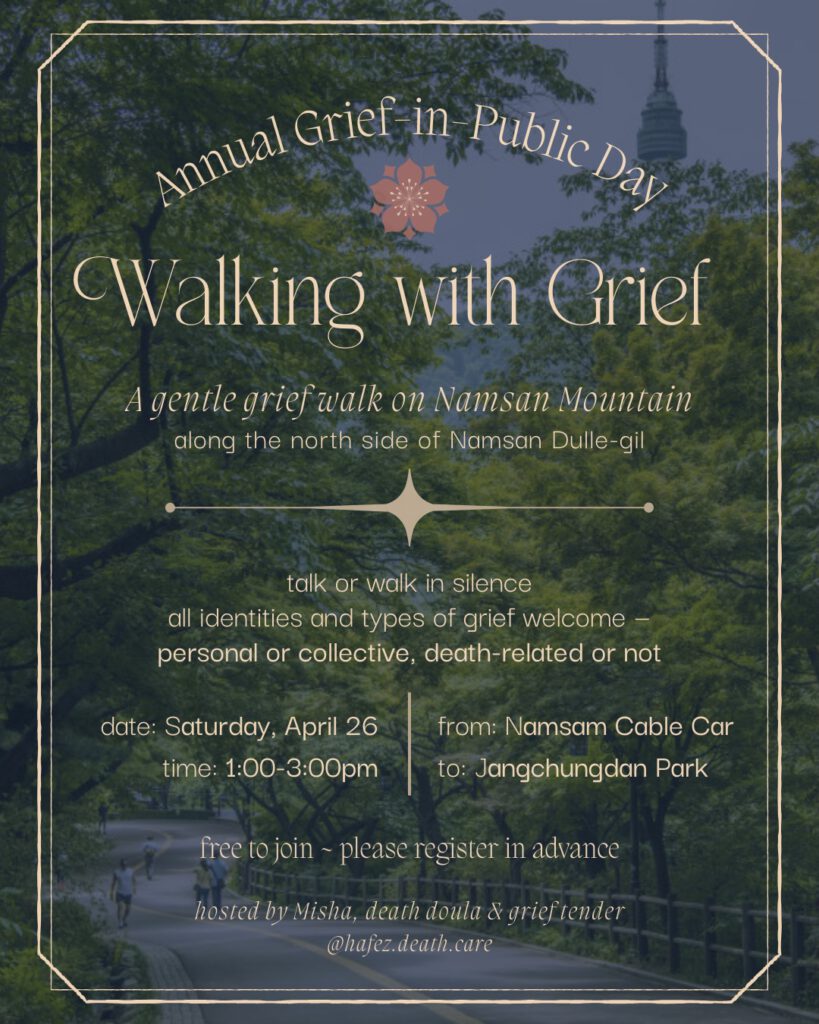
Today I want to share about my first event I’m hosting as a death doula: a community grief walk in Seoul, in honor of Annual Grief-in-Public Day.
This event is close to my heart. Not just because it marks the beginning of my work in this field, but because I believe so deeply in what it represents.
Why Grieve in Public?
Grief-in-Public Day, observed this year on April 27, 2025, is about pushing back against the idea that grief should stay hidden. Most of us have been conditioned to think that sorrow is something to be managed quietly. That we should cry behind closed doors, or “be strong” for others. That showing sadness makes people uncomfortable. And so, many of us grieve in isolation.
That’s certainly been true for me. So much of my grief has happened in solitude. And while there is power in private mourning, there is also something incredibly healing about being seen in your sorrow. When we grieve in public, we interrupt the myth that grief is shameful, inconvenient, or too much. We create space for others to say: me too.
Even when I’ve allowed myself to cry in public, it’s rare that I’m in a space where that grief is welcomed—where it’s held with care. That’s what this day is about. Making space in the world for our grief to be witnessed. To be acknowledged. To be met with empathy.
The Origin of the Grief Walk
When I began imagining what kind of event I wanted to offer for this day, I sat down in front of my altar and asked my ancestors, my guardians: How can I best serve my comunity? What came to me was a walk. A simple, community grief walk.
If I had tried to think of an idea logically, I wouldn’t have thought of it. Walking? It’s too simple. Too ordinary. But something in me knew that this was exactly what we need in this moment. Because grief work doesn’t always need to be heavy or complex. It needs to be honest. It needs to be embodied. And often, it needs to be shared.
Why Walking?
We so often default to talk therapy when it comes to grief. And don’t get me wrong—storytelling and conversation are incredibly important. They help us name our losses, make sense of them, and feel less alone. But talk therapy addresses the grief in our minds. What about the grief in our bodies?
That’s where movement comes in. Our bodies need to move grief. To express it. To release it. And walking is one of the simplest, most accessible ways to do that.
On a physiological level, walking activates bilateral stimulation—a rhythmic, left-right movement that helps regulate the nervous system and process emotions. If you’ve heard of EMDR therapy (Eye Movement Desensitization and Reprocessing), used to help people suffering from trauma, you might know that this left-right motion helps people reprocess and integrate painful experiences.
The same is true for Bilateral Drawing that is a technique often used by art therapists in which you drawing with both hands at once. The bilateral movement calms the mind and brings you into you body.
Walking can have a similar effect. The gentle rhythm of your steps, the movement of your body, the left-right pattern—all of it helps shift the energy of grief. It gives your body a role in healing.
From Personal to Collective
This grief walk is about more than individual healing. It’s about practicing collective care. It’s about recognizing that we’re all carrying grief—some of it personal, some of it ancestral, some of it collective. And in this moment of unraveling, where so many systems are collapsing around us, we need places to grieve together.
We talk a lot about community care, but we don’t always know what that looks like. This is one way. Holding space for one another. Bearing witness. Letting others see the tender, unfiltered parts of ourselves.
Because grief is a teacher. For me, grief has taught me empathy. I am able to see and feel other people’s grief and empathize with their sorrow. That empathy builds trust. It builds a connection, a bond. And from that trust grows solidarity.
When I see your grief, I see your humanity. And when I see your humanity, I’m moved to fight for you. That’s how movements are built. Not just through strategy, but through deep emotional connection established through shared grieving.
The Future We’re Building
I do this work because I believe in a liberated future. A future where we are safe. Where we are free. Where care isn’t a luxury, but a birthright. And I believe grief work is part of getting us there.
When we tend to our grief in community—when we let it change us, teach us, soften us AND we allow others to tend to our grief with us—we become more connected to the people in our lives. More able to build communities rooted in compassion. More dedicated to fighting alongside them. More committed to the work of collective liberation.
So if you’re in Seoul on April 26, I invite you to join us. The walk is free, open to all, and hosted with love.
You can sign up at hafezdeathcare.com
If you’re not in Seoul, find your local death doulas and death workers, see if they are hosting an event for Annual Grief-In-Public Day. The death workers are leading this movement and you are welcome to join.
This is activism. This is community. This is the future we’re building—one step at a time.